
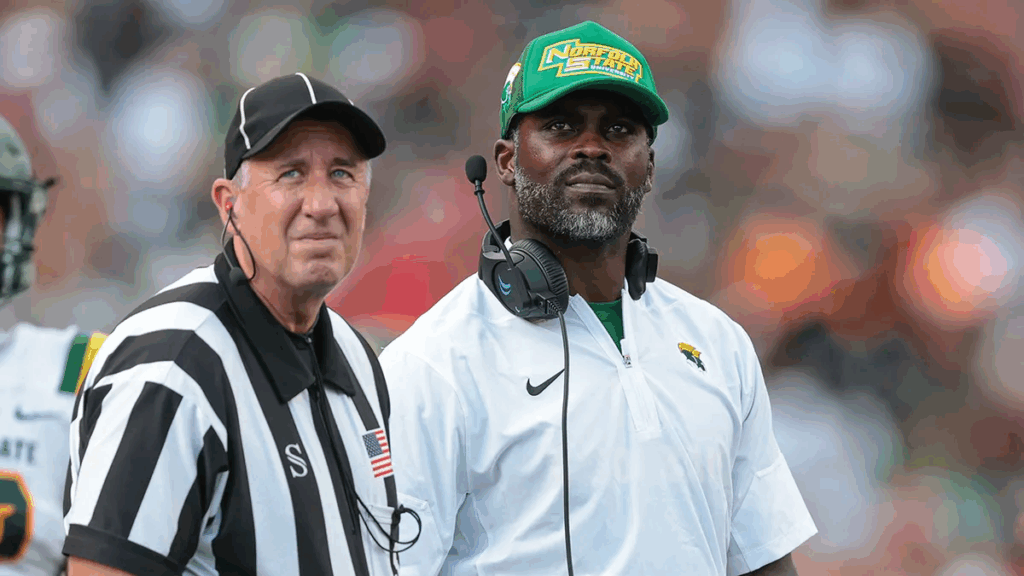
Following the tumultuous conclusion of his debut season as head football coach, Michael Vick is taking his painful lessons and channeling them into an unambiguous vision for the future of Norfolk State University. The first year, which saw the Spartans stumble to a challenging 1-11 overall record—the program’s lowest win total since 2004—was, by Vick’s own account, a crucible of growth. Far from being defeated by the harsh realities of the Mid-Eastern Athletic Conference (MEAC), the former NFL MVP views the experience as an invaluable, accelerated education.
The solitary bright spot on the schedule for the Spartans was a thrilling 34-31 overtime victory against Virginia State. However, a tough 0-5 slate in conference play left no doubt that the transition from NFL icon to college head coach is steep, unforgiving, and humbling.
Speaking exclusively with ScoopB.com about the emotional and professional challenges of the season, Vick provided an honest assessment of his first year on the sidelines.
His reflections on the immense learning curve reveal a man fully committed to the grind of building a winning program from the ground up.
The Steep Ascent of the Learning Curve
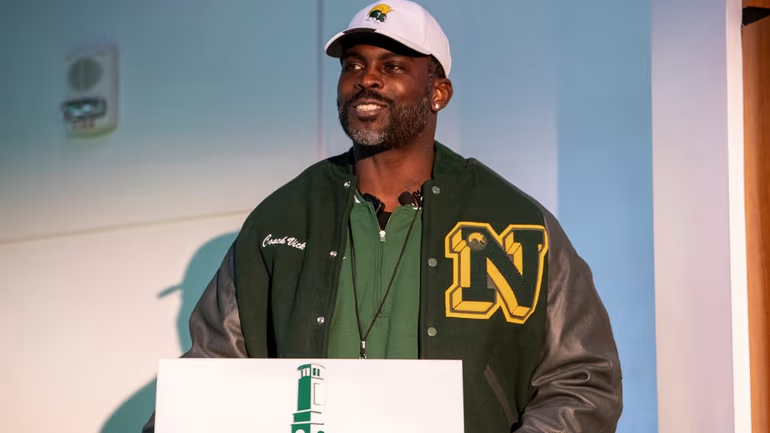
Stepping into the head coaching role at an HBCU, especially one with a program historically fighting for consistency, carries a weight that only those in the position can truly understand. Vick confirmed the magnitude of this challenge, highlighting that his greatest lessons were not strategic, but profoundly relational.
Vick explained the nature of his initial education in coaching:
“The learning curve was learning people, learning players, learning my coaches,” Michael Vick told me.
“Learning how this conference operates, learning how I operate; it’s definitely a huge learning curve, but I feel like that I got so much invaluable information that I wish next season started tomorrow.”
Vick’s account of this season is a testament to the comprehensive nature of his job. “Learning people” speaks to the nuances of motivating Gen Z athletes and building a culture; “learning my coaches” is about organizational leadership and delegating authority; and “learning how I operate” is a moment of raw self-reflection; understanding his own strengths and weaknesses as a leader under pressure.
The profound belief that he is already equipped with the necessary knowledge leads to his immediate desire to implement changes, demonstrating the infectious, forward-looking optimism that defines high-level competitors.
The Fellowship of the Fight: Counsel from Football’s Unconventional Leaders

When navigating a 1-11 season, isolation is a common temptation. Vick admitted to spending much of the season shouldering the burden himself, but he found mentorship in the most relevant places: with other high-profile coaches who have forged non-traditional paths and faced severe scrutiny.
When asked if he had any coaches he leaned on for mentorship, Vick responded:
“Throughout the course of this season, I left a lot of coaches alone, man,” he shared.
“I was going through something that a lot of coaches probably never went through being that 1-11, but I did talk to [Coach] Prime and I did talk to Coach Hugh Jackson and a couple of other coaches, man but it was something that they could relate to and something that they’ve already been through and the only thing they told me was, ‘Keep fighting on…’”
The fact that Vick sought out Coach Prime (Deion Sanders) and Hugh Jackson is highly significant, as both men represent the challenging and often unconventional journey of coaching. The nature of their advice—the simple, yet powerful, mantra—suggests a fellowship among coaches who understand the long-term mental and emotional battle required to sustain a program through intense difficulty.
Deion “Coach Prime” Sanders: The HBCU Effect and National Spotlight
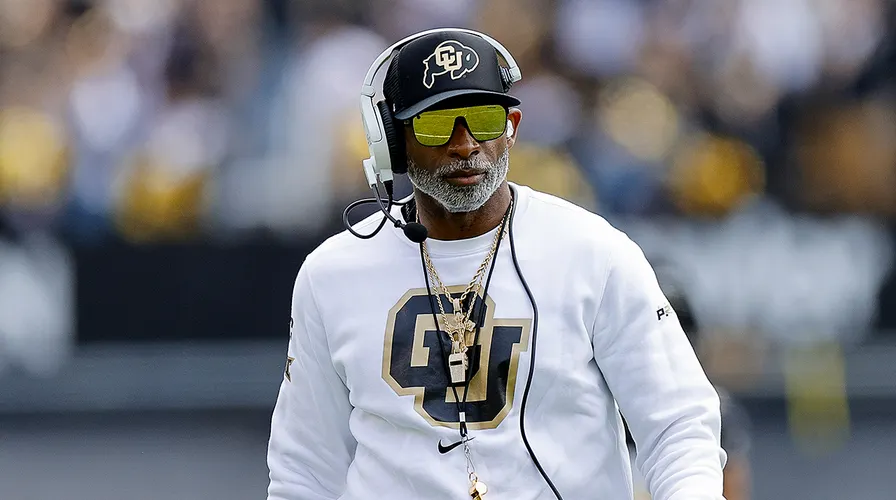
The advice from Coach Prime, Deion Sanders, carries immense weight in the context of HBCU football. Sanders built his coaching reputation by taking on the challenge of elevating Jackson State, a journey that required a complete transformation of the program’s infrastructure and national profile. While Sanders’ initial experience was immediately more successful than Vick’s, his presence and influence legitimized the path of a high-profile former NFL star coaching in the HBCU environment.
Sanders’ own coaching career, marked by a massive cultural shift and the ability to attract top talent, validates Vick’s presence in the MEAC. Prime’s success at JSU, including back-to-back SWAC titles, proved that a charismatic NFL legend can successfully revitalize an HBCU program and bring national attention. The message of “Keep fighting on…”from Sanders is an affirmation of the necessity of enduring the grind and trusting his unique vision, echoing the experience of having to fundamentally change a program’s narrative and culture.
Hugh Jackson: The Ultimate Test of Resilience

Hugh Jackson’s inclusion in Vick’s circle is particularly poignant. Jackson’s coaching resume is decades long, but he is perhaps most known for his challenging tenure as the head coach of the Cleveland Browns, where he recorded a historically difficult 3-36-1 record from 2016-2018, including a grueling 0-16 season.
Jackson’s experience with extreme, public losing gives him a unique and profound perspective on the isolation Vick described. To hear “Keep fighting on…” from Jackson is not a hollow platitude but a testament to sheer professional resilience. Jackson, who has since dedicated himself to the HBCU mission as a coach at Grambling State, embodies the belief that a coach must endure the darkest seasons to eventually see success.
His ability to move on and dedicate himself to the college game, despite his past NFL record, provides Vick with a crucial blueprint for survival and sustained commitment.
An Unwavering Vision for the Future
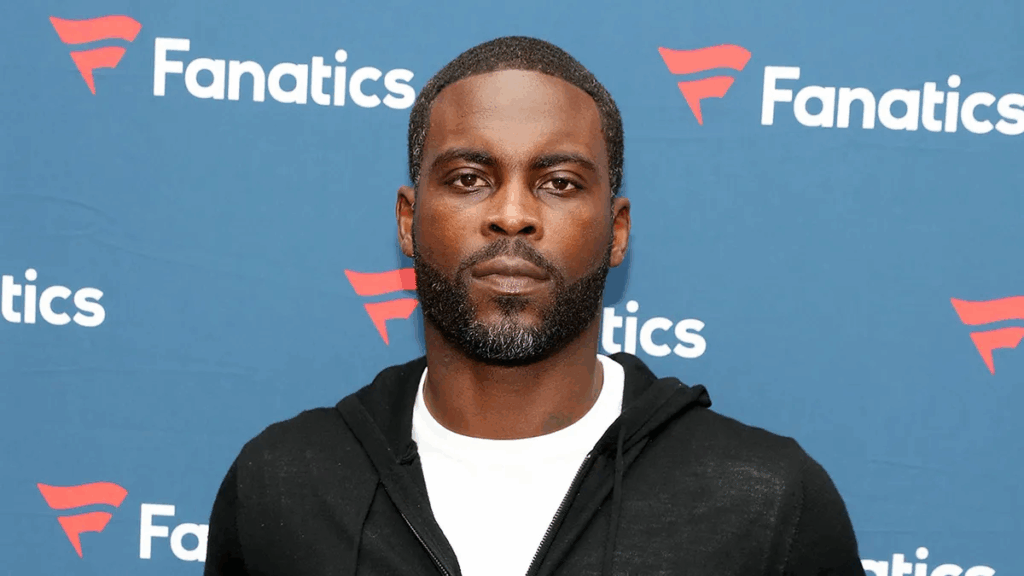
The counsel from both Sanders and Jackson is rooted in unconventional success and profound resilience, respectively and has clearly fortified Vick’s determination. The humility of the first season has not fractured his belief in his ability to lead but has instead sharpened his focus on the singular goal for year two.
The experience, he believes, has provided him with the foundation, knowledge, and drive to immediately push for success, stating, “I feel like that I got so much invaluable information that I wish next season started tomorrow.”
When asked the inevitable, forward-looking question about the program’s horizon, Vick’s answer was quick, direct, and uncompromising:
“What’s next? A winning season!”
This is not merely a slogan; it is a declaration of intent built upon the “invaluable information” he has acquired. The learning curve of 1-11 has taught Michael Vick the personnel, the operational dynamics, and the psychological fortitude required to succeed. The lessons from Coach Prime taught him the power of presence and unique vision; the counsel from Hugh Jackson taught him the necessity of enduring adversity.
For Michael Vick and the Norfolk State Spartans, the debut season was an investment. It was the cost of the education, paid in losses, scrutiny, and hard work. With the knowledge gained, the mentorship secured, and a singular goal now fixed on the horizon, the expectation for a dramatic turnaround is now set. Vick’s promise is clear: the first chapter was about learning; the next will be about winning.