
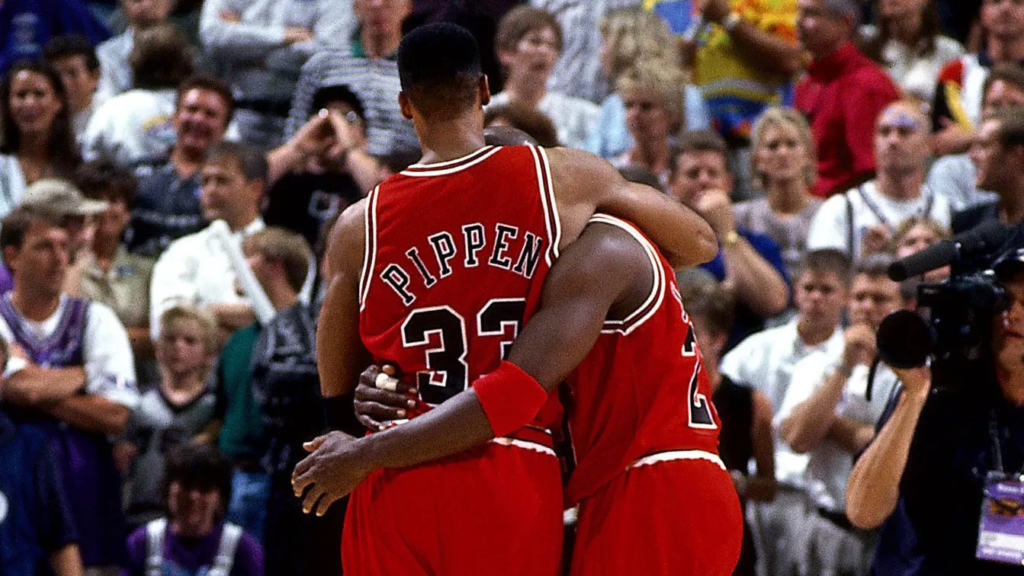
A six-time NBA Champion, an Olympic gold medalist and one of the NBA’s original point forwards, Scottie Pippen never shied away from competition—even when that competition was Michael Jordan.
“I wanted to be better than Michael Jordan,” Pippen said flatly.
That statement—bold, unfiltered, and steeped in the ethos of 1990s basketball—wasn’t born out of arrogance, but out of a relentless drive to prove himself. Pippen didn’t enter the league with fanfare. Like Charles Oakley before him, he came from humble beginnings and a small school. But that background bred a special kind of confidence.
“There was something there to give me the confidence just to talk shit,” Pippen said. “I had a journey like Oakley coming from a small school. Just having that confidence in myself instilled more confidence.”
That confidence would be tested early in his career under then-Bulls head coach Doug Collins. Pippen, who came into the NBA as a point guard, found himself playing out of position.
“I came in this league as a point guard and [was] put at small forward,” Pippen explained. “I was kinda learning the game from a position that I was never put in.”
That would change with the arrival of Phil Jackson.
“Phil Jackson was really a players coach,” Pippen said. “He had a great understanding of how the game was evolving.”
It was under Jackson’s guidance that Pippen became the Swiss Army knife of the Bulls’ triangle offense. His ability to defend multiple positions, initiate the offense, and guard the opposing team’s best scorer became the foundation of Chicago’s dynasty.
While Jordan took the spotlight, Pippen often took the assignment—and the heat. During an era brimming with fierce competitors and elite scorers, Pippen held his own.
He listed Gary Payton, Larry Bird, and Adrian Dantley as the biggest trash talkers of his era.
The 1990s were a golden era in the NBA—an age of icons and intensity. And for Pippen, getting past the Detroit Pistons—famously known as “The Bad Boys”—was the ultimate test. The Bulls fell short multiple times before finally breaking through in the 1991 Eastern Conference Finals.
Although Oakley was no longer on the team by then—having been traded to the New York Knicks for Bill Cartwright—Pippen says Oakley’s influence still mattered.
“Charles Oakley helped us in the journey to beat the Detroit Pistons,” he reflected.
The rivalries were fierce, the expectations even fiercer. But through it all, Scottie Pippen’s journey was defined by adaptability, fire, and the will to match—if not surpass—the greatness that surrounded him.